MOTS-c vs. NAD+: Which Energy Peptide Is Right for You?
MOTS-c and NAD+ are both associated with cellular energy, but they work in different ways — NAD+ is a coenzyme your cells use directly in energy production, while MOTS-c is a signaling peptide associated with metabolic flexibility. They’re not interchangeable, and many people ask whether the two can be used together. Here’s how they compare.
What Is NAD+?
NAD+ (nicotinamide adenine dinucleotide) is a coenzyme found in every cell of your body. It plays a central role in cellular energy production and is involved in many processes your cells rely on every day. NAD+ levels are understood to decline with age, which is a major reason it has become one of the most talked-about molecules in healthy aging.
For a deeper primer, see What Is NAD+? (add link)
What Is MOTS-c?
MOTS-c is a peptide encoded in the DNA of your mitochondria, the structures that produce energy in your cells. It acts as a signaling molecule and is associated with supporting metabolic flexibility, meaning how well your body shifts between fuel sources, as well as training adaptation and stress response. Much of the research on MOTS-c is still early and preclinical, so realistic expectations matter.
MOTS-c vs. NAD+ at a Glance
| NAD+ | MOTS-c | |
|---|---|---|
| What it is | A coenzyme used directly by cells | A mitochondrial-derived signaling peptide |
| Role | Supports cellular energy production | Supports metabolic flexibility |
| Most associated with | Energy, healthy aging, mental clarity | Metabolic adaptation, training response, steady energy |
| Feels like a stimulant? | No | No |
| Research stage | Widely studied as a coenzyme | Largely early and preclinical |
How They Differ
One is a building block, the other a signal. NAD+ is a molecule your cells consume and rely on as part of producing energy. MOTS-c acts more like a message, signaling how your metabolism responds to demand.
Different focus. NAD+ is the one most associated with overall cellular energy and healthy aging. MOTS-c is the one most associated with metabolic flexibility and how the body adapts to exercise and stress.
Different maturity of research. NAD+ as a coenzyme is very well understood. Research on MOTS-c as a supplement is newer and has largely been conducted in preclinical settings.
Which Should You Choose?
- If your interest is overall cellular energy and a healthy aging routine, NAD+ is the more common starting point. See our oral dissolving NAD+ strips.
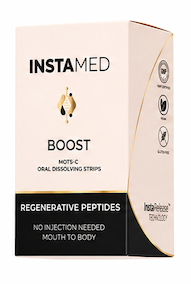
- If your interest is metabolic flexibility, training response, and steadier energy, MOTS-c is the one designed around that. Explore InstaMed MOTS-c.
- If you’re curious about both, they’re often discussed together because they’re associated with different parts of the energy picture. A qualified provider can help you decide whether to use one or both.
Delivery Format Matters for Both
Peptides and coenzymes like these are chains or large molecules that your digestive system is built to break down, which is why a swallowed capsule faces a real obstacle. Oral dissolving strips are designed to sidestep that by delivering through the tissue under the tongue. See our guide to needle-free peptide options for how the formats compare.
What to Realistically Expect
Neither is a stimulant, and neither is an overnight fix. Both are generally used consistently over time, results build gradually, and individual response varies. They work best alongside the basics: sleep, nutrition, movement, and stress management.
Getting Started
If you’re deciding between MOTS-c and NAD+, or wondering about using both, our team is happy to talk through your goals.
Ready to explore? Explore InstaMed NAD+ or InstaMed MOTS-c, or learn more on our sublingual NAD+ and sublingual MOTS-c pages. We’re here to help you make sense of your options, one strip at a time.
None of the statements on this page/article/post have been evaluated by the Food and Drug Administration. These peptides are not intended to diagnose, treat, cure, or prevent any disease. These peptides have also not been approved by the FDA for human consumption and should be used for research purposes only. Use of this peptide for any other reason is at your own risk and is not recommended nor approved by the FDA. Consult with a qualified healthcare provider before beginning any supplementation protocol.