BPC-157 vs. TB-500: What’s the Difference?
Short answer: BPC-157 and TB-500 are two different peptides that are often discussed together because both are associated with supporting the body’s natural tissue maintenance — but they work through different pathways, which is why many people see them as complementary rather than competing. BPC-157 is most associated with tissue and gut-lining support, while TB-500 is most associated with cell movement and flexibility. Here’s how they compare.
What Is BPC-157?
BPC-157, short for “Body Protection Compound,” is a peptide originally derived from a protein found in the stomach. It’s most commonly associated with supporting the body’s natural maintenance of connective tissue like tendons and ligaments, muscle, and the gut lining. It’s one of the most widely discussed peptides in the recovery and wellness space.
For a deeper primer, see What Is Oral BPC-157?
What Is TB-500?
TB-500 is a synthetic fragment of Thymosin Beta-4, a naturally occurring peptide found throughout the body. It’s most commonly associated with supporting cell migration, meaning how cells move to where they’re needed, as well as flexibility and general tissue maintenance.
BPC-157 vs. TB-500 at a Glance
| BPC-157 | TB-500 | |
|---|---|---|
| Origin | Derived from a stomach protein | Fragment of Thymosin Beta-4 |
| Most associated with | Tissue and gut-lining support | Cell movement and flexibility |
| Common focus | Tendons, ligaments, muscle, gut | Flexibility, broad tissue maintenance |
| Often used | On its own or in a blend | On its own or in a blend |
How They Differ
Different pathways. BPC-157 is associated with supporting the processes involved in tissue maintenance at a localized level, while TB-500 is associated with supporting how cells migrate and organize. They aren’t two versions of the same thing.
Different areas of emphasis. BPC-157 is the one more often discussed for the gut lining as well as connective tissue. TB-500 is more often discussed in terms of flexibility and overall movement of cells through tissue.
Different research histories. Both are studied more extensively in laboratory and preclinical settings than in large human trials, so it’s worth keeping expectations realistic and working with a qualified provider.
Why Are They Often Paired?
Because they’re associated with different parts of the picture, BPC-157 and TB-500 are frequently discussed as complementary. One is associated with tissue-level support, the other with how cells move to support that process. That’s the thinking behind blends that combine them.
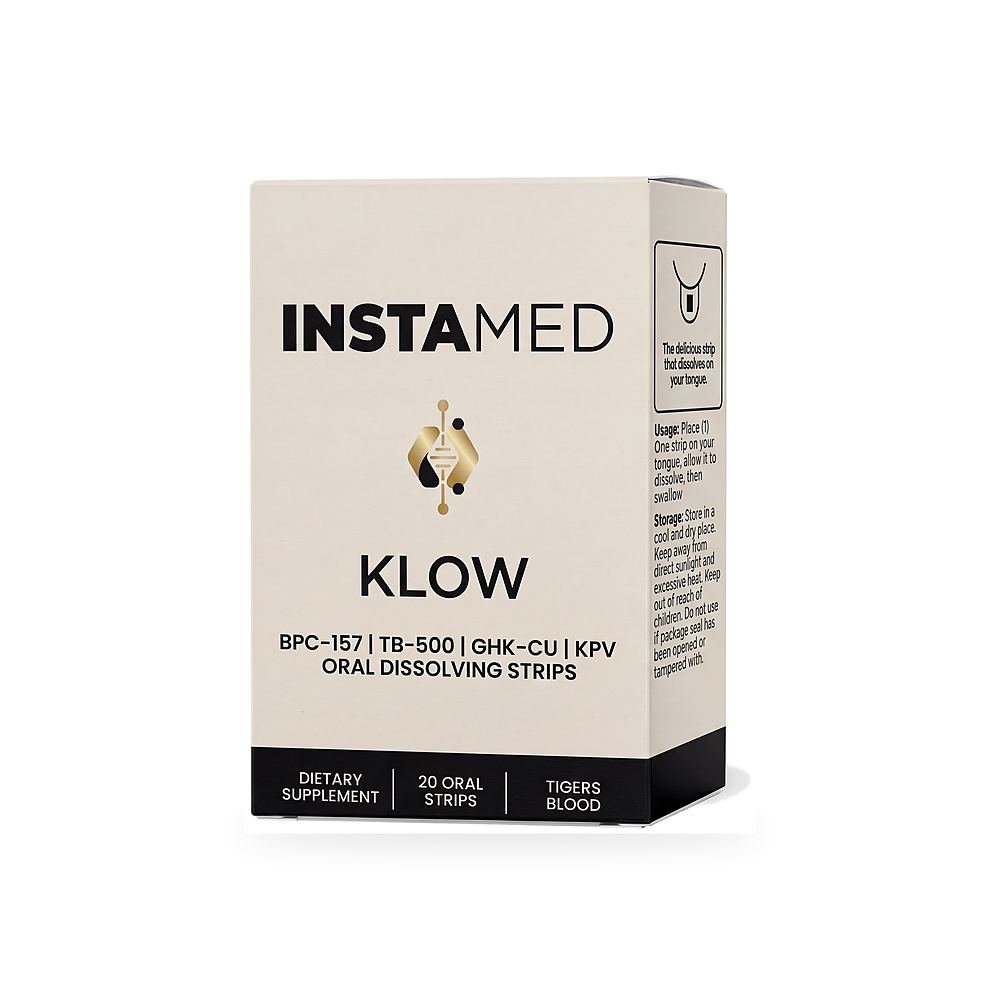
InstaMed KLOW is one example: a four-peptide strip combining BPC-157 and TB-500 with GHK-Cu and KPV, bringing recovery-focused and beauty-focused support into a single oral dissolving strip.
Which One Should You Choose?
There isn’t a single right answer, and it depends on what you’re interested in:
- If you’re mainly interested in tissue and gut-lining support, BPC-157 is the more commonly chosen starting point. See our oral dissolving BPC-157 strips.
- If you’re interested in both, a blend that includes both peptides, like KLOW, offers a convenient single-strip option.
Either way, a conversation with a qualified provider is the best way to decide what fits your goals.
A Note on Format
Peptides are chains of amino acids, and your digestive system is built to break those chains down, which is why a swallowed capsule faces a real obstacle. Oral dissolving strips are designed to sidestep that by delivering peptides through the tissue under the tongue. For a closer look at the options, see our guide to needle-free peptide options.
What to Realistically Expect
Both peptides are best approached as part of a broader routine that includes sleep, nutrition, and appropriate activity, not as quick fixes. Individual response varies, and the regulatory landscape around peptides like BPC-157 is still evolving, so it’s worth working with a provider who can keep you informed.
Getting Started
If you’re weighing BPC-157, TB-500, or a blend that includes both, our team is happy to walk through the options with you.
Ready to explore? Explore InstaMed BPC-157 or InstaMed KLOW. We’re here to help you make sense of your options, one strip at a time.
None of the statements on this page/article/post have been evaluated by the Food and Drug Administration. These peptides are not intended to diagnose, treat, cure, or prevent any disease. These peptides have also not been approved by the FDA for human consumption and should be used for research purposes only. Use of this peptide for any other reason is at your own risk and is not recommended nor approved by the FDA. Consult with a qualified healthcare provider before beginning any supplementation protocol.